Daytona Weekend Logistics is not a side issue around the racing. At Daytona International Speedway, crowd movement, parking capacity, tram timing, seating access, Midway activity, and post-race traffic all shape how a major race weekend functions around the competition itself.
The Coke Zero Sugar 400 weekend is scheduled to run from August 27-30, 2026, at Daytona International Speedway, with the track’s published schedule identifying the event window and weekend operations Daytona schedule. That date range matters because the venue is not operating as a single-race facility for one evening. It is managing several days of arrival waves, infield access, fan-zone traffic, seating loads, and departure pressure.
For a superspeedway, logistics become part of the event’s competitive frame. Fans are not simply moving toward a grandstand; they are moving through a facility built around a 2.5-mile racing surface, a large infield, multiple parking zones, shuttle routes, hospitality areas, and a frontstretch seating structure designed to handle major national-series crowds. The operational question is not whether the Speedway can host volume. It is how cleanly that volume is sorted before and after peak race windows.
Daytona Weekend Logistics Starts Before Green Flag
Arrival Timing Is A Capacity Tool
The research notes for Daytona event weekends advise fans to arrive four to five hours before race time. For a 7:30 PM race example, that means arriving between 2:30 PM and 3:30 PM. That is not simply a comfort recommendation. It spreads the load across parking access, security checks, Midway circulation, food lines, seating entry, and infield movement.
At Daytona, early arrival also protects the racing experience. Superspeedway events generate long pre-race build-up, and late arrivals can collide with the heaviest pedestrian flows toward grandstands and fan areas. A fan who reaches the property early has more margin to move between the Midway, concessions, seating sections, and transport pickup points without compressing every step into the final hour before command and pace laps.
Daytona Weekend Logistics For Arrival Windows
Daytona Weekend Logistics is most visible when arrival windows narrow. A surge of vehicles in the final two hours before a feature race can load the same road network, parking entry lanes, shuttle queues, and pedestrian crossings at once. By contrast, a four-to-five-hour arrival model lets the Speedway process fans in layers.
That matters for the venue and for the competition environment. A smoother arrival curve reduces last-minute crowd pressure near gates and lowers the risk that large numbers of spectators are still in transit as pre-race ceremonies begin. It also helps separate fan movement from credentialed operational movement around the track, where teams, officials, media, and event staff have different timing needs.
Parking Pressure Is The First Stress Test
Free And Paid Parking Create Different Fan Paths
Daytona uses a mix of free and paid parking depending on the event. The research identifies free parking in certain lots for many events, while paid parking in closer lots such as Lot 1, Lot 4, Lot 3, and Lot 8 is available for some weekends and often requires advance purchase. From a race-weekend operations view, this creates two different fan paths: proximity-based access for those parked close to the Speedway and transport-dependent access for those routed farther out.
For Daytona Weekend Logistics, the difference is not only walking distance. Lot assignment affects which tram or shuttle line becomes relevant, how quickly fans reach the Fanzone or grandstands, and how exposed they are to post-race exit queues. A fan parked close to the facility may face less inbound transfer time but can still be locked into dense exit traffic after the race. A fan in an outlying lot may need more inbound planning but can sometimes benefit from structured shuttle routing.
Roar Before The Rolex 24 Showed The Ceiling
The pressure was clear on January 17, 2026, during the Roar Before the Rolex 24 preseason event. Parking reached capacity early, forcing overflow lots outside the Speedway and shuttle operations into the facility; single-day admission that day was $25 and included free parking while available Yahoo Sports report.
That example is useful because the Roar is not the same fan profile as a NASCAR Cup race, yet it still stressed parking supply. It showed how quickly demand can exceed on-site assumptions when weather, interest, pricing, and schedule density align. For larger weekends, the lesson is direct: parking is not a passive amenity. It is a managed resource that can define the first competitive impression of the day.
Trams, Shuttles, And Infield Movement
Color-Coded Lines Reduce Decision Load
The research identifies Yellow, Purple, Green, and Red tram or shuttle lines connecting outlying lots, including areas such as Lot 6 West and Lot 1, to Speedway access points, the Fanzone, and infield areas during race weekends. Color-coded movement systems are common at large venues because they reduce decision load. Fans do not need to understand every road inside the property; they need to understand which line connects their parking zone to their destination.
This is especially relevant at Daytona because the infield is not a minor add-on. It is part of the venue’s race-weekend identity, with access patterns that differ from a simple oval grandstand entry. Moving spectators toward infield areas, then back toward seating or exit points, requires a transport plan that can absorb changing demand through the day.
Transport Timing Extends Beyond The Race
Race-day trams and shuttle lines are listed in the weekend operations as running from early morning through post-race periods. The post-race element is the harder test. Before a race, arrivals are spread across several hours. After the checkered flag, departures compress into a much tighter window as grandstands, infield areas, and hospitality sections release fans into the same system.
That is where transport planning intersects with race craft for the fan. A superspeedway finish can keep the crowd in place until the last lap because pack racing at Daytona rarely feels settled early. Once the race ends, the same tension that held spectators in their seats becomes a sudden movement wave. For those tracking the competitive side of the Coke Zero Sugar 400 weekend, venue flow sits beside items such as Daytona race strategy because both are shaped by timing, sequencing, and reaction to changing conditions.
The Grandstand Rebuild Changed Fan Throughput
Daytona Rising Shifted The Capacity Model
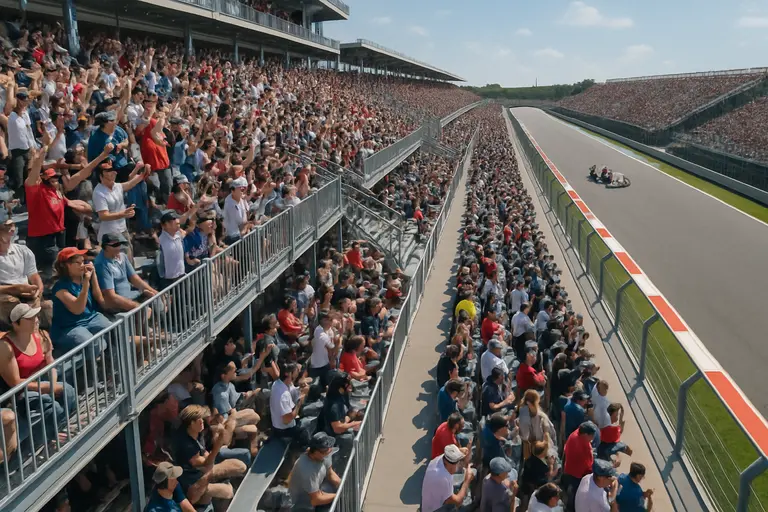
The Daytona Rising project, completed by early 2016, changed the Speedway’s fan infrastructure. The research notes that frontstretch seating was reduced from roughly 146,000 to about 101,500 permanent seats, while every seat was replaced with a wider design. It also states that restrooms doubled, concession stands tripled, and more than 60 luxury suites were added.
That changed the operating equation. Fewer permanent seats does not mean a smaller logistical challenge; it means the Speedway chose a different balance between capacity, comfort, circulation, and revenue areas. Wider seats and expanded restrooms can reduce friction inside the grandstand structure. More concession points can distribute queues rather than forcing fans into a few overloaded nodes.
Comfort Has A Competitive Function
Comfort is not separate from racing consumption. At Daytona, long green-flag runs, stage breaks, weather exposure, and pre-race programming require fans to stay oriented for several hours. If restroom access, food queues, or seating discomfort pull too much attention away from the track, the racing product is harder to follow.
The Midway also extends the day. Research describes vendor booths, merchandise, live entertainment, autograph opportunities, cooling tents, and food and drink options outside the grandstands. That type of fan zone gives the venue more ways to absorb early arrivals. It also turns the four-to-five-hour arrival recommendation into usable time rather than dead time in a parking lot.
Post-Race Exit Is The Hardest Phase
The Checkered Flag Compresses Demand
Post-race traffic is the phase least able to hide weak planning. The research notes that fans often face elevated exit times after the checkered flag, with 30 to 45 minutes before traffic begins to ease and, in some cases, more than 60 minutes to leave the property depending on parking location and routing through corridors such as I-95, I-4, and beachside routes.
That range is realistic for a venue with Daytona’s footprint. Even with strong internal routing, every parking lot must feed into a limited number of external roads. The exact delay depends on where a fan parked, how quickly pedestrians clear, how traffic control prioritizes certain exits, and whether shuttle riders or walking traffic create temporary choke points near loading areas.
Exit Strategy Is Part Of The Fan Plan
For race operations, exit delay is not just a convenience metric. It affects emergency access, staff movement, transit staging, and the public perception of the event. A close finish can sharpen that pressure because fewer fans leave early. Daytona’s racing format makes that likely: the decisive laps often carry the highest tension, so the crowd tends to stay until the end.
The venue’s challenge is to protect that sporting payoff while processing the departure surge. Fans who stayed for the finish should not feel as if the final racing memory is immediately replaced by uncontrolled gridlock. That is the operational standard for a facility built around major events.
Daytona Weekend Logistics As A Race-Day System
The best reading of Daytona Weekend Logistics is as a connected system rather than a list of amenities. Arrival advice, parking assignment, tram lines, Midway design, seating upgrades, concession volume, and exit routing all influence one another. If one layer is stressed, pressure moves to the next layer.
The August 27-30, 2026 Coke Zero Sugar 400 weekend tests that system across multiple days, not only during the feature race window. Daytona has the benefit of a rebuilt frontstretch, established shuttle patterns, and experience with major NASCAR and IMSA crowds. The January 17, 2026 parking capacity event at the Roar Before the Rolex 24 also showed that demand can still outrun expectations.
That is why the fan experience at Daytona should be analyzed with the same discipline used for race strategy. The goal is sequencing: get people parked, screened, transported, seated, served, and released without overwhelming any one point. When that sequence works, the Speedway’s scale supports the racing rather than competing with it for attention.