The IMSA Stricter Penalties reset did not come from an abstract rule debate. It followed a visible conduct problem at Road America, where the 2026 six-hour round produced nine full-course yellows tied to single-car and multi-car incidents, according to RACER reported. For a series built around multi-class precision, that level of interruption changes race engineering, stint execution and championship risk.
As of August 27, 2026, the Virginia International Raceway weekend of August 20-23, 2026, had already taken place. The supplied research does not include the race result or a verified post-race penalty count from VIR, so the cleanest analysis is not a results recap. It is an assessment of what IMSA’s enforcement signal meant before VIR and what it is likely to mean for the remaining competitive phase after August 27.
Why IMSA Stricter Penalties Changed Race Control
IMSA’s public message on August 21, 2026, was direct: drivers would be held more accountable after recent dust-ups. Senior competition leadership, including Simon Hodgson and Race Director Beaux Barfield, signaled that the sanctioning body wanted to reverse what it viewed as a softer enforcement tone earlier in 2026 compared with the end of 2025.
IMSA Stricter Penalties And Driver Standards
The core conduct areas are not unusual: avoidable contact, blocking, failure to leave racing room and incidents that force race control into repeated safety interventions. The competitive effect, though, is substantial. A driver who previously defended to the very edge of the stewarding tolerance band now has to assume that the same move may be judged differently.
That shifts the calculus in three places: braking-zone overlap, corner-exit squeeze and restart positioning. In each case, the driver is not only weighing whether a move can gain position. The driver is weighing whether the move can survive review if it creates contact or leaves another car without usable road.
The Road America Trigger Point
Road America matters because it is not a street-circuit anomaly or a single bottleneck race. It is a long, fast natural-terrain circuit where prototype and GT traffic can separate and rejoin across braking zones. Nine full-course yellows at a six-hour race suggest more than one bad judgment call. They create a pattern race control cannot ignore without inviting escalation at later rounds.
For engineers, repeated full-course yellows also distort the planned race model. Fuel windows compress, tire degradation targets change, driver rotation timing gets reworked and undercut logic loses clarity. In endurance racing, discipline is not a courtesy issue; it protects the strategic structure of the event.
VIR Became The Immediate Conduct Test
The Michelin GT Challenge weekend at VIR ran from August 20-23, 2026, and it became the first visible enforcement test after the Road America criticism. IMSA framed the event around cleaner GT racing, with drivers expecting tighter scrutiny at a circuit where track position and patience are tightly linked. The sanctioning body also pointed back to the 2025 VIR event, where six GTD PRO/GTD competitors were penalized for incident responsibility, as IMSA previewed.
That history made VIR a useful case study even before any 2026 post-race data was available. GT-only or GT-focused racing removes some prototype traffic variables, but it also compresses the field’s performance range. Cars arrive at braking zones with similar capability, which puts more emphasis on driver judgment, setup compromise and pit-cycle timing.
GT Traffic And Risk Allocation
VIR rewards commitment through high-speed sections, but passing often depends on forcing a small advantage into a braking zone or pressuring a rival into a compromised exit. Under tighter enforcement, that pressure has to be applied with more care. The gain from a late move must be compared with the time loss of a penalty, the loss of class position and the possible damage to championship points.
The immediate engineering consequence is conservative risk allocation, not slower racing. Teams still need drivers to attack. The difference is where they attack. A move with clear overlap and predictable exit space becomes more valuable than an optimistic nose inside at a corner where contact is likely. A defensive line that removes racing room becomes a liability rather than a demonstration of race craft.
What Is Known After August 23
Because the supplied research stops before verified VIR results and penalty totals, any claim that IMSA’s stance definitively succeeded or failed at VIR would be unsupported. What is supported is that VIR was positioned as the first conduct pressure point after Road America. Our earlier VIR race demands preview framed the weekend around GT traffic density, sprint rhythm and the need to manage risk without giving up pace.
That distinction matters. Enforcement policy should be judged over several races, not one event viewed through incomplete evidence. A single clean race can come from driver caution, track rhythm or fewer restart clusters. A single messy race can come from weather, timing or one incident that spreads through the pack. The trend is what matters.
Strategic Effects For Teams And Drivers
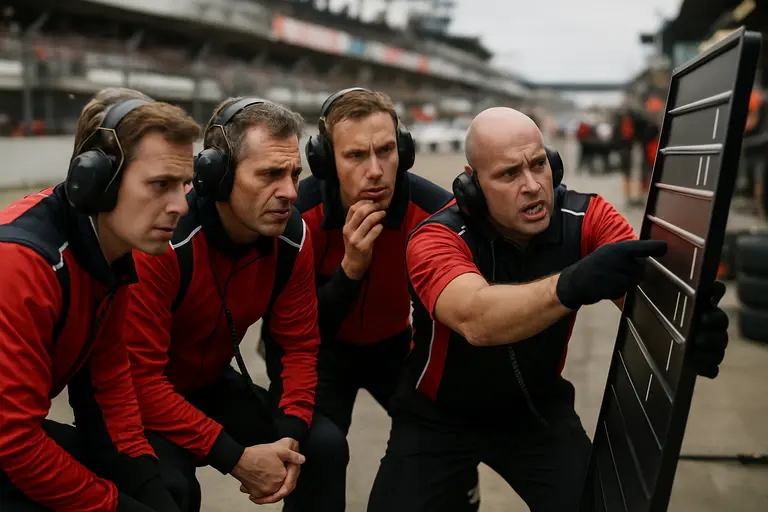
The practical impact of IMSA Stricter Penalties is that teams must account for stewarding exposure before the race, not only after an incident occurs. Driver briefings become more specific. Video references become more valuable. Engineers have to define which corners allow assertive defense and which corners demand margin.
Restart Discipline And Pass Selection
Restarts are the clearest pressure point. Tire temperature, brake temperature and traffic stacking all combine to create opportunity and hazard. If IMSA is less willing to let borderline contact pass without consequence, a driver may need to prioritize the second corner after the restart rather than the first braking zone.
That can change radio communication. Instead of a simple message to push, the stand may need to warn about specific cars, recent stewarding calls or corners where contact risk is high. This is race engineering as behavioral management. The fastest theoretical stint means little if it ends with a drive-through, a probation risk or a position penalty.
Compliance As Race Engineering
Teams already manage fuel numbers, tire life, brake migration and traffic gaps. Conduct compliance now sits in that same operational stack. The aim is not to make drivers passive. The aim is to reduce low-percentage incidents that trade a possible overtake for a near-certain review.
Data supports that process. Onboard video, throttle traces, brake pressure, steering input and proximity timing can all help a team understand whether a move was defensible before it becomes a penalty hearing. A driver who knows the team will review those markers may adjust sooner, especially in multi-car packs where the first contact often triggers the larger incident.
- Drivers may leave more exit space when overlap is established.
- Engineers may identify corners where defending is strategically too costly.
- Strategists may delay a pass attempt until tire or traffic conditions improve.
- Team managers may use clearer pre-race thresholds for acceptable contact risk.
The teams that adapt fastest are not necessarily the least aggressive. They are the teams that separate controlled aggression from penalty exposure with fewer ambiguous moves.
IMSA Stricter Penalties After VIR And Beyond
The next phase for IMSA Stricter Penalties is consistency. Drivers can adjust to firm enforcement. What they cannot easily manage is uncertainty from race to race. If avoidable contact, blocking and failure to leave racing room are judged with a stable standard, teams will build that standard into simulation, briefing notes and race strategy.
The championship implication is direct. Penalties do not only cost time in the moment. They can change points distribution, manufacturer outcomes and driver confidence in wheel-to-wheel situations. A team that keeps its cars clean through restarts and traffic cycles may gain as much from avoided penalties as from raw stint pace.
IMSA’s task is to preserve hard racing without allowing repeated contact to become an accepted method of passing. That balance is narrow, but the Road America response made the intent clear. After August 27, 2026, every remaining IMSA race should be viewed through that enforcement filter: speed still wins, but race control tolerance has become part of the competitive equation.