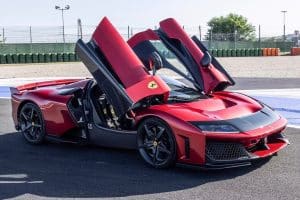
The Porsche 911 GT3 RS has always stood as a benchmark for precision engineering, and the 2026 “Next Evolution” model elevates that legacy even further. Rather than chasing raw horsepower figures alone, Porsche continues to refine what truly matters: aerodynamics, control, and driver engagement.
In a supercar world increasingly dominated by hybrid systems and electrification, the GT3 RS remains refreshingly committed to a purist philosophy. It is not designed to be the fastest in a straight line it is engineered to dominate corners, circuits, and the senses.
Design Philosophy: Function Over Flash
The most striking feature is the massive rear wing, inspired by motorsport technology and equipped with a Formula 1-style Drag Reduction System (DRS). This allows the car to adjust aerodynamic drag dynamically, offering both maximum downforce in corners and reduced resistance on straights.
The front fascia is equally aggressive, with large air intakes and active aero elements that channel air precisely where it’s needed. The result is a machine that produces extraordinary levels of downforce, keeping it glued to the track even at high speeds.
Aerodynamics: The Real Game-Changer
If there is one area where the 2026 GT3 RS separates itself from competitors, it is aerodynamics. Porsche has pushed the boundaries of what is possible in a road-legal car.
The car generates over 800 kg of downforce at high speed, a figure that rivals some race cars. This is achieved through a combination of active aerodynamics, underbody airflow management, and advanced wing design.
Key innovations include:
- Active front diffusers that adjust in real time
- A fully functional DRS system
- Optimized airflow channels across the body
These features work together seamlessly, ensuring the car remains stable, responsive, and predictable under extreme conditions.
Engine and Performance: Naturally Aspirated Excellence
In an era where turbocharging and hybridization dominate, Porsche has stayed true to its roots with a high-revving naturally aspirated flat-six engine.
Producing approximately 518 horsepower, the engine may not sound outrageous compared to hybrid hypercars, but numbers don’t tell the full story. What makes this engine special is its immediacy and character.
It revs beyond 9,000 RPM, delivering a raw, mechanical soundtrack that is increasingly rare in modern supercars. The throttle response is instantaneous, providing a level of connection between driver and machine that electrified systems often struggle to replicate.
Acceleration is sharp and linear, but the real magic happens when the car is pushed through corners, where power delivery and chassis balance work in perfect harmony.
Driving Dynamics: Precision Beyond Compare
Driving the GT3 RS is an experience that borders on transformative. It is not merely fast it is surgically precise.
The steering is incredibly communicative, offering detailed feedback about the road surface and tire grip. Combined with a finely tuned suspension system, the car responds instantly to driver inputs.
What truly sets it apart is how approachable it feels despite its performance capabilities. While it is undeniably a track-focused machine, Porsche has engineered it in such a way that skilled drivers can confidently explore its limits without feeling overwhelmed.
The braking system is equally impressive, delivering consistent stopping power even under repeated high-speed use. Carbon-ceramic brakes ensure minimal fade, making the GT3 RS ideal for extended track sessions.
Interior: Built for the Driver
Step inside, and the GT3 RS reveals a cockpit designed with a singular focus: driving.
The interior is stripped of unnecessary luxuries, emphasizing lightweight materials and ergonomic design. Carbon fiber elements, Alcantara finishes, and supportive bucket seats create an environment that feels purposeful and immersive.
The steering wheel features integrated controls for adjusting suspension, traction, and aerodynamics, allowing drivers to fine-tune the car’s behavior in real time. This level of customization ensures that the GT3 RS can adapt to different track conditions and driving styles.
Despite its track-oriented nature, the cabin still retains a level of refinement expected from Porsche, balancing performance with usability.
Technology and Innovation: Motorsport Meets Road
The GT3 RS is a prime example of how motorsport technology can be translated into a road-legal package.
From its advanced aerodynamics to its adjustable driving modes, the car incorporates lessons learned from Porsche’s racing programs. The integration of systems such as torque vectoring, adaptive suspension, and real-time data feedback ensures optimal performance at all times.
This is not technology for the sake of convenience it is technology designed to enhance performance and driver control.
Everyday Usability: Surprisingly Manageable
While the GT3 RS is clearly built for the track, it is not entirely impractical for road use. The ride is firm, as expected, but not punishing. Visibility is decent, and the car can be driven in everyday conditions with relative ease.
However, it’s important to note that this is not a traditional daily driver. Its low ride height, aggressive aero, and track-focused setup make it better suited for enthusiasts who prioritize performance over comfort.
Final Verdict: A Masterclass in Driving Purity
The 2026 Porsche 911 GT3 RS (Next Evolution) is not about following trends it is about perfecting a philosophy. In a time when many supercars are becoming heavier and more complex due to electrification, Porsche has delivered a machine that remains focused, engaging, and uncompromising.
It may not boast the highest horsepower figures or the latest hybrid technology, but it offers something far more valuable: a pure, unfiltered driving experience.
For those who appreciate precision engineering and track performance, the GT3 RS stands as one of the finest supercars available today. It is not just a car—it is a statement of what driving should feel like.