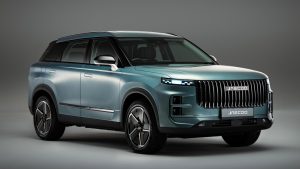
The timing of the HiPhi X matters more now than it did at launch. In a global EV market that has shifted from exuberant expansion to ruthless consolidation, this vehicle stands as both a product and a warning: a reminder that technical ambition alone does not guarantee survival.
When I look at the HiPhi X, I do not just see another premium electric SUV. I see one of the clearest expressions of how far China’s EV industry pushed design, software, and luxury positioning in a very short period. The car arrived with the visual shock of a concept vehicle and the price tag of an elite flagship, yet it also arrived in a market that was becoming brutally unforgiving even to companies with serious engineering credentials.
Why The HiPhi X Still Commands Attention
What made the HiPhi X impossible to ignore was not a single number on a spec sheet. It was the total package. Human Horizons designed a full-size electric SUV that seemed determined to reject the usual premium-EV template. The silhouette was dramatic, the lighting was theatrical, and the door system became its calling card: rear-hinged coach doors paired with upper gullwing sections that opened automatically. Even in a segment obsessed with novelty, this was a machine that demanded attention before it even moved.
Inside, the message was equally clear. The cabin leaned hard into screen-rich, lounge-style luxury, with multiple large displays, an executive feel in higher-end seating layouts, and a technology stack built to signal that software had become part of the luxury experience itself. That mattered because premium buyers increasingly expect an EV to behave like a connected device as much as a car. The HiPhi X understood that shift early and built its identity around it.

HiPhi X Key Specifications
| Category | HiPhi X Snapshot |
|---|---|
| Vehicle Type | Full-size luxury electric SUV |
| Battery | 97 kWh |
| Drivetrain | Dual-motor all-wheel drive |
| Output | Up to about 440 kW / 590 hp |
| 0–100 km/h | About 3.9 seconds |
| Range | Up to 550 km CLTC |
| Charging | DC fast charging, 10–80% in roughly 45 minutes |
| Seating | Four-seat and six-seat configurations |
Design As Strategy, Not Decoration
I think the most revealing thing about the HiPhi X is that its wild design was not superficial. It was strategic. In the luxury EV race, especially in China, brands needed to create distinction fast. Legacy prestige was not available to newer entrants, so they had to manufacture desirability through spectacle, technology, and an almost architectural approach to form.
That is where the HiPhi X excelled. Its automated “NT” doors were more than a party trick. They were a statement of intent, meant to tell buyers that this brand belonged in a conversation usually dominated by Tesla, Mercedes-Benz, BMW, and Porsche. The exterior projected confidence. The interior projected digital sophistication. Together, they formed an argument that premium mobility could be reimagined around interaction, automation, and visual drama rather than heritage alone.
A few features defined that strategy especially well:
- Automated multi-panel door system designed to create a signature arrival experience
- Large-format cockpit screens and a passenger-centric digital layout
- Software-heavy identity built around voice control, connectivity, and over-the-air evolution
Performance, Comfort, And The Luxury EV Equation
On paper, the HiPhi X delivered what a flagship electric SUV needed to deliver. The power figure was substantial, acceleration was genuinely quick for a large vehicle, and the battery size put it in serious territory. In practical terms, that meant the vehicle could support the emotional side of premium ownership as well as the rational one. It was fast enough to feel special, large enough to feel indulgent, and technologically ambitious enough to justify its premium positioning.
But the more interesting question is whether those attributes translated into enduring competitive strength. My reading is that the HiPhi X proved how close newer Chinese brands had come to the top of the market in terms of product confidence. At the same time, it exposed how fragile that position could be when scale, capital requirements, and market competition intensified. Building a vehicle that turns heads is difficult. Building a sustainable business around it is much harder.
Where The HiPhi X Stood Out Most
| Area | What The HiPhi X Offered | Why It Mattered |
|---|---|---|
| Exterior Identity | Futuristic body, dramatic lighting, complex powered doors | Instant differentiation in a crowded EV market |
| Cabin Experience | Multi-screen interior, luxury seating, high-spec finishes | Helped position the model as a true flagship |
| Performance | Strong output and sub-4-second sprint to 100 km/h | Matched the expectations of premium EV buyers |
| Tech Positioning | Software-led UX, connectivity, evolving feature set | Reinforced the idea of the car as a digital platform |
The Bigger Story Behind The Vehicle
This is where the HiPhi X becomes more than an automotive curiosity. Human Horizons later faced severe financial pressure, and HiPhi’s operations were disrupted as China’s EV market entered a punishing phase of price competition and shakeout. That changes how the vehicle should be understood today. It is no longer just a luxury EV with unusual doors and a lavish cabin. It is a case study in the gap between product excellence and business durability.
I think that context gives the HiPhi X unusual importance right now. The car captured a moment when Chinese EV makers were not merely catching up to global competitors but trying to leapfrog them in design language, software ambition, and premium storytelling. It showed how quickly a new entrant could create a vehicle that felt world-class in presentation. Yet it also underscored the brutal reality that in the EV business, admiration does not cancel out economics.
Why The HiPhi X Matters Right Now
The HiPhi X matters today because it tells two stories at once. First, it proves that the center of gravity in automotive innovation has shifted, with Chinese manufacturers capable of producing vehicles that are bold, technically credible, and culturally influential. Second, it shows how unforgiving the current EV market has become, even for brands that appear to have momentum and imagination on their side.
For me, that is what makes this SUV memorable. The HiPhi X was not just trying to compete; it was trying to redefine what a luxury EV could look and feel like. In an industry now sorting winners from casualties in real time, that ambition feels more relevant than ever. The car remains a striking symbol of how innovation can surge ahead of certainty, and why that tension is shaping the electric future right now.