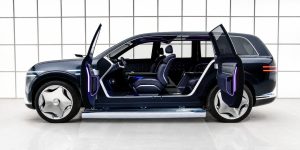
Dreame Technology spent less than a year turning itself from a robot-vacuum specialist into one of the loudest would-be newcomers in the performance-car world. Now the Dreame electric car project is being wound down before a production vehicle ever reached customers, turning a rocket-assisted hypercar promise into a useful warning about how brutally difficult car manufacturing remains.
The reversal lands especially hard because Dreame’s ambitions were never modest. Earlier this year, the company was being discussed alongside far more established performance brands, including in the new hypercar war. The bigger lesson now is not that an appliance company should never build a car. It is that generating attention is dramatically easier than creating a vehicle business capable of surviving after the unveiling lights go dark.
Dreame Went From Automotive Newcomer to Exit in About a Year
Dreame announced its move into premium electric vehicles in August 2025, promising luxury products and eventually promoting concepts that suggested extraordinary performance.
By August 2026, that plan had reversed. The company confirmed it was withdrawing its automotive project after reassessing the industry’s development complexity, capital demands and competitive intensity. The automotive withdrawal came before commercial production began.
Reporting around the shutdown says the automotive operation once approached 1,000 employees but had been reduced to only a few dozen people as activities were wound down. Dreame says technology and intellectual property developed during the effort can be redirected into areas including smart mobility, robotics and broader research.
That may reduce the financial damage. It does not make the change of direction any less striking.
Automotive ambition met reality.
The Rocket Car Was Perfect for Attention
Nothing represented Dreame’s strategy more vividly than the Nebula Next 01 Jet Edition.
The concept appeared in San Francisco in April with an astonishing pitch built around rocket assistance and extreme acceleration. Dreame promoted a claimed 0-to-100-km/h time of 0.9 seconds, the kind of figure designed to make conventional supercars look suddenly old.
It worked as a headline.
But a spectacular specification sheet and a functioning production program are very different achievements. Later reporting raised serious questions about how representative some Dreame display vehicles were of actual engineering progress. The reported prototype concerns included allegations from former employees that at least one earlier show car lacked a functioning production-style chassis and relied heavily on display-model construction.
Those claims deserve careful attribution because they come from reporting and former employees, not a public engineering audit. Still, they reinforce the central problem: the distance between a show-stopping concept and a validated automobile can be enormous.
A reveal is not production.
Building Cars Punishes Shortcuts Consumer Tech Can Survive
A technology company can prototype a new appliance, redesign an enclosure and iterate relatively quickly. A car has to satisfy an entirely different stack of requirements.
Crash safety, thermal management, suspension durability, braking, steering, corrosion, software, cybersecurity, homologation, supplier validation, warranty support and manufacturing consistency all have to work together. A defect in one subsystem can trigger problems across thousands of vehicles.
That complexity becomes especially unforgiving in a hypercar.
| Risk | Concept Stage | Production-Car Reality |
|---|---|---|
| Extreme performance | Generates attention quickly | Requires repeatable, validated hardware |
| Battery technology | Impressive specifications can be announced | Cells need safety, durability and supply at scale |
| Prototype design | One show vehicle can be hand-built | Customer cars must meet consistent standards |
| Supplier network | Small quantities are manageable | Production needs dependable quality and volume |
| Software | Features can be selectively demonstrated | Systems must work in unpredictable conditions |
| Capital | Funding gets prototypes built | Factories, tooling and warranties consume far more |
Automotive history is full of beautiful concepts because creating one extraordinary car is difficult but achievable.
Creating thousands of identical, safe and reliable examples is another business entirely.
Scaling is the expensive part.
Xiaomi Shows the Opposite Side of the Tech-Company Bet
Dreame’s withdrawal does not prove that technology companies cannot enter the car industry.
Xiaomi proves otherwise.
The smartphone and electronics giant approached automotive expansion with enormous resources, dedicated manufacturing capacity and products intended for genuine volume. Its SU7 moved beyond internet renders and motor-show excitement into customer deliveries, followed by a broader vehicle strategy.
That comparison is uncomfortable but useful.
A successful technology-company move into cars requires more than transferable software expertise or a recognizable consumer brand. It demands factories, supply chains, crash testing, regulatory approvals, battery sourcing, dealer or service infrastructure and years of warranty responsibility.
Those costs begin long before an automotive operation necessarily becomes financially attractive.
For every outsider that makes the transition look easy, another discovers that cars consume capital relentlessly.
The industry can be disrupted. It simply cannot be skipped.
Hypercar Numbers Have Become Too Easy to Promise
Electric propulsion has intensified another problem: outrageous performance figures have become unusually effective marketing currency.
Instant torque, multi-motor drivetrains and rapidly improving battery systems allow legitimate manufacturers to deliver acceleration that would have seemed absurd a decade ago. An unknown company therefore needs an even more extraordinary number if it wants instant international attention.
That creates a credibility problem.
A claimed horsepower figure, battery energy density or acceleration time means little until a real vehicle can repeat it safely. Readers increasingly need to separate a design study from a running prototype, a running prototype from a production-intent vehicle, and a production-intent vehicle from something customers can actually buy.
Dreame’s automotive adventure compressed that entire distinction into roughly one year.
The wildest number in a presentation may ultimately be the least meaningful one.
The Next EV Startup Needs to Prove the Boring Stuff First
The most revealing signal from Dreame’s retreat will be how investors, consumers and automotive media treat the industry’s next ambitious outsider.
Before becoming impressed by acceleration figures, ask whether the company has production tooling, validated suppliers and a credible homologation path. Before assuming a launch is inevitable, look for manufacturing capacity, service plans, warranty support and evidence that prototypes are progressing toward production specifications.
None of that means automotive innovation should become cautious. Tesla, Rimac and several Chinese manufacturers demonstrate what can happen when outsiders challenge assumptions established automakers once considered permanent.
But bold engineering becomes meaningful only when it survives mundane engineering.
The Dreame electric car project never reached commercial production, and that makes its collapse more instructive than another impossible acceleration claim. Dreame demonstrated how quickly a company can capture automotive attention. Its retreat demonstrates something far harder: attention cannot stamp body panels, validate batteries, manage suppliers, pay warranty claims or manufacture thousands of reliable vehicles.
The next company promising to reinvent the automobile should still dream outrageously big.
Before believing the horsepower number, though, ask to see the factory.