The VeeKay Podium Finish at the Milwaukee Mile on August 30, 2026, was more than a recovery drive from the back third of the field. Rinus VeeKay started 24th in Race 1 of the Snap-On Makers & Fixers 250 doubleheader and finished third, giving Juncos Hollinger Racing its second podium in team history, according to a Yahoo Sports report. For a mid-grid INDYCAR operation trying to convert isolated peaks into repeatable execution, that kind of result changes the internal measurement of what the No. 76 entry can demand from itself.
JHR’s first INDYCAR podium also came at Milwaukee, when Conor Daly finished third in Race 1 in 2024. That parallel matters. Two podiums at the same oval do not prove dominance, but they do suggest the team has found a competitive operating window at Milwaukee across more than one driver cycle. The 2026 result also came with higher season context: VeeKay reached a career-best eight top-10 finishes, climbed back into 10th in the Drivers’ Championship, and had one round remaining after Milwaukee, per the same Yahoo Sports report.
What The VeeKay Podium Finish Proved At Milwaukee
Race Position Gain And Oval Execution
The clean headline is 24th to third. The engineering value sits underneath that number. A driver cannot gain 21 positions on an oval through pace alone if the pit sequence, traffic management, tire life, and timing calls do not align. JHR did not need a front-row start to reach the podium; it needed an execution chain that kept the car competitive across the run and avoided the operational losses that punish teams starting deep in the order.
That is why the VeeKay Podium Finish should be read as a systems result rather than only a driver highlight. VeeKay’s racecraft created the visible gain, but a recovery of that scale forces every department into the result: race engineering, pit crew, fuel and tire modeling, spotter communication, and the timing of strategic decisions. If any one of those areas fails, the recovery stalls somewhere short of the podium.
Oval Milestone For VeeKay
The Milwaukee result was also VeeKay’s first oval podium in the NTT INDYCAR Series, a milestone noted in a JHR release. That matters for team dynamics because driver confidence on ovals is inseparable from trust in the car’s balance, the information coming over the radio, and the timing of pit calls. A first oval podium with a new team strengthens that loop.
For JHR, the value is sharper because the team’s 2026 campaign had already included a sixth-place finish in the Indianapolis 500 on May 24, 2026, which was its best-ever Indianapolis 500 finish and VeeKay’s personal best at the event. Put Milwaukee beside Indianapolis and the pattern becomes more meaningful: the team was not relying only on road-course variation or isolated attrition. It was producing stronger results in high-pressure oval formats where track position and pit-lane precision are exposed.
Pit-Lane Gains And Strategy Control
VeeKay Podium Finish As A Crew Benchmark
The No. 76 crew’s early-2026 jump from 16th to second in the Firestone Pit Stop Performance rankings among 27 full-time entries gave JHR a measurable internal target before Milwaukee. That kind of pit-lane gain does not guarantee a podium, but it changes the strategy map. A team with slow or inconsistent stops has to protect against losses. A team with competitive stops can call races more aggressively because the pit lane becomes an opportunity rather than a liability.
The VeeKay Podium Finish therefore reinforced a key operational point: JHR’s race strategy could be built around execution rather than damage limitation. Starting 24th, the car needed clean stops and calm calls to keep the recovery alive. If a crew believes it can gain or hold position during service, the driver receives a different type of race. Instead of being asked to offset pit-lane losses on track, the driver can manage stints with the expectation that the crew will protect the work already done.
How Pit Confidence Changes The Stand
Team morale in INDYCAR is often discussed in broad terms, but it is built through repeatable tasks. A strong stop confirms training. A clean strategy phase confirms preparation. A podium confirms that both can survive race pressure. That feedback has direct value for JHR because the group is still building its competitive identity against more established organizations.
Milwaukee gave the timing stand a stronger case for trusting its process. It also gave mechanics and engineers a shared reference point. The next internal discussion about risk, stint length, or pit timing can point to an actual podium recovery rather than an abstract target. That does not remove execution risk, but it makes the standard easier to define.
Driver Feedback And Team Dynamics
Leadership Through Setup Direction
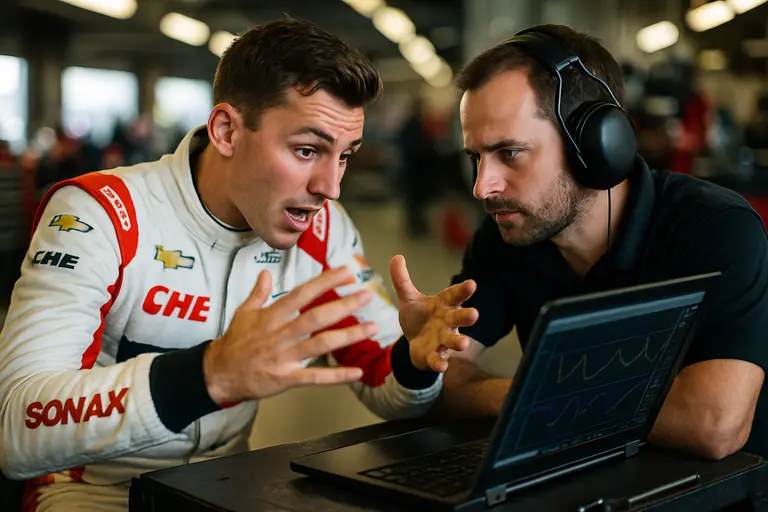
VeeKay joined Juncos Hollinger Racing for the 2026 season, and his results have given the team a clearer performance center. The research record credits him with contributing to engineering feedback, setup development, and racecraft growth inside the program. Those areas are difficult to quantify from outside the garage, so the safest reading is not that one driver alone changed the team. The more precise interpretation is that his feedback and race execution gave JHR a consistent reference point around which to organize the No. 76 effort.
That can be especially important for a team scaling its expectations. When a driver repeatedly reaches the top 10, the engineers receive better data on where the car is genuinely limited. When the same driver converts 24th on the grid into third, the group can separate setup quality from qualifying position and race circumstance. That separation is valuable. It keeps a team from overcorrecting after a poor starting spot and helps preserve confidence in a race package that may still have competitive life.
Why The Result Matters Internally
By September 4, 2026, the Milwaukee result stood as JHR’s first podium of the 2026 season. That timing gave it a strong internal effect. Late-season podiums can reset how a team reviews its year because they show which processes held up after months of race-week pressure. In JHR’s case, the result arrived after a season that had already included the Indianapolis 500 sixth-place finish and a career-best top-10 count for VeeKay.
The VeeKay Podium Finish also sharpened the competitive stakes around the final round at WeatherTech Raceway Laguna Seca, which had not yet been run as of September 7, 2026. With VeeKay back to 10th in the Drivers’ Championship after Milwaukee and JHR seeking its best championship finish, the team’s internal task was not to celebrate a single podium in isolation. It was to protect the execution standards that made the result possible.
JHR’s Competitive Identity After Milwaukee
Juncos Hollinger Racing’s Milwaukee performance did not suddenly make it a front-running INDYCAR benchmark. The field is too deep, and one podium does not erase the difference between a rising program and the teams that contend every week. What it did create was evidence that JHR can combine driver performance, pit-lane progress, and race strategy into a complete result under oval pressure.
That distinction matters for how a team manages itself. A lucky result can lift a mood for a week. A structured recovery from 24th to third can influence how departments prepare, debrief, and assign accountability. The mechanics can point to pit-lane progress. The engineers can point to a race package that survived traffic. The timing stand can point to decisions that kept the car in contention. The driver can point to an oval breakthrough that confirms the relationship is producing results.
The most important impact of the VeeKay Podium Finish is that it gave JHR a usable standard. Not a slogan, not a projection, and not a theoretical pace claim: a race result built from measurable movement through the field. If JHR carries that standard into its next competitive cycle, Milwaukee may be remembered less as an isolated trophy and more as the point where the No. 76 operation proved its stronger 2026 form could withstand race-day pressure.