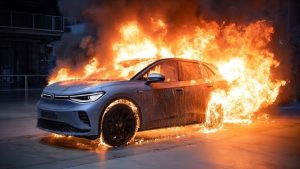
The Lucid Air fire recall is not a battery-fire story, and that is exactly what makes it interesting. Lucid is recalling 27,185 Air sedans from model years 2022 through 2026 because an exterior-lighting circuit can overheat, yet the remedy is software rather than replacement wiring.
That turns a conventional recall into a test of the software-defined car. Modern EVs already rely on code for charging, driver assistance and safety fixes, a shift that has made owners feel increasingly like software beta testers. Lucid’s case pushes the idea further: can software control a physical electrical risk well enough that replacing hardware is unnecessary?
The Lucid Air Fire Recall Is Bigger Than the Number
Lucid’s action covers 27,185 U.S. vehicles, making it the company’s largest recall to date. The affected population is also larger than the 15,841 vehicles Lucid delivered during all of 2025.
The recall says the exterior-lighting circuit may have insufficient overcurrent protection, allowing it to overheat. That can increase fire risk. A failure could also knock out front lighting or the center brake light, reducing visibility and creating a separate crash risk.
Owners are being told to park affected cars outside and away from structures until the remedy is completed. Lucid had already pushed the software fix to 20,719 vehicles when the recall became public.
That is a striking example of a recall arriving after the fix.

A Software Fix for a Physical Electrical Risk
The affected low-voltage lighting circuits use an electronic fuse, or eFuse, controlled by software. Older logic could allow current to remain above the intended protection threshold long enough for wiring or components to overheat.
Lucid’s remedy, software version 2.10.0 or later, lowers the applicable eFuse amperage threshold and changes the logic so a faulted circuit does not repeatedly re-energize during the same key cycle. The technical recall breakdown also describes three fire incidents, four smoke incidents and 33 warranty reports potentially associated with the condition.
The hardware remains in the car. The code changes the conditions under which electricity is allowed to keep flowing through it.
That is the key distinction. Software is acting as the protective device, not merely reporting that something has failed.
The approach can work if the components remain safe inside the revised electrical limits. The real test is whether that protection remains effective through years of temperature changes, vibration and everyday use.
This Is Not a High-Voltage Battery Recall
The words “EV” and “fire” naturally push attention toward the traction battery. That is not what this recall describes.
The problem concerns low-voltage exterior-lighting circuits. Modern EVs still contain conventional electrical networks alongside their high-voltage propulsion systems. Headlights, brake lamps, controllers and sensors still depend on wiring and current protection.
That makes this a reminder that electric-car reliability is not only about cell chemistry or battery thermal runaway. An EV can have an advanced battery pack and still face a familiar electrical-engineering problem elsewhere.
The important distinction is not every EV fire risk is a battery risk.
That matters because treating every electric-vehicle fire issue as a battery problem makes it harder for owners to understand the actual failure mechanism. Here, the concern is electrical load management in lighting circuits, not the large battery underneath the passenger compartment.
The Risk Picture Is Broader Than Fire
The recall contains several risks that are easy to collapse into one alarming headline.
Risk AreaWhat the Recall DescribesPractical MeaningCircuit overheatingExterior-lighting circuit may exceed safe current limitsHeat can damage wiring or componentsFireOverheating can create a fire riskOwners are told to park outside until remediedLighting lossFront lights or center brake light may stop workingVisibility can fallSoftware statusUpdated software changes eFuse protection logicAn OTA update can complete the remedyUnupdated vehiclesSome cars had not received the fix at filingVIN and software status still matter
Owners should not interpret “OTA recall” as “nothing to do.” The fix may arrive wirelessly, but the correct software still has to be installed before the safety action is complete.
That distinction becomes especially important when an update is delivered automatically or sits waiting for owner approval. A recall can be technically available without being completed on a particular vehicle.
Can Software Be a Permanent Automotive Repair?
OTA recalls are one of the clearest benefits of connected cars. A manufacturer can correct some safety problems without filling service bays, shipping thousands of parts or asking every owner to surrender a vehicle for a day.
But software fixes are not all alike.
Sometimes code corrects code: a display bug or control error is repaired by changing the program itself. Lucid’s recall is more interesting because software is being used to keep a physical circuit inside safer operating limits.
That does not automatically make the remedy inferior. Electronic current protection is standard engineering. The question is whether the revised limits prevent overheating without creating nuisance shutdowns or lighting failures.
That is where software-defined safety becomes more demanding than software-defined convenience.
It also changes what drivers should think of as a “repair.” The traditional idea involves a technician replacing a failed physical component. In a connected vehicle, engineers may sometimes achieve the same safety outcome by changing how existing hardware is permitted to operate.
The Next Signals Matter More Than the Download Count
The first number to watch is recall completion. Lucid had already updated 20,719 of the 27,185 affected vehicles, but owners should verify their own cars through the federal VIN lookup rather than assume an automatic update was installed.
The second signal is field performance after version 2.10.0. If overheating, smoke and lighting failures disappear, this could become a strong example of software containing a physical electrical hazard. If related incidents continue, pressure for hardware changes would grow.
The third is what other automakers learn. Cars increasingly use software-controlled power distribution rather than relying only on traditional fuses and isolated controllers. Regulators will have to judge when changing code genuinely repairs a defect and when it merely works around hardware with insufficient margin.
The Lucid Air fire recall therefore matters beyond one luxury EV. It shows how the definition of an automotive repair is changing.
Lucid is betting that revised protection logic can accomplish a safety goal that once would have meant replacing physical parts. If the remedy holds up, connected vehicles gain a powerful argument for OTA safety fixes. If it does not, the industry will learn the opposite lesson: software can manage hardware risk, but it cannot be allowed to hide it.