The Milwaukee Mile strategy picture for the 2026 NTT INDYCAR SERIES doubleheader starts with two pressures that rarely separate on a short oval: raw pace and race degradation. The weekend is scheduled to feature the Snap-on Makers and Fixers 250 on Saturday, August 29, 2026, followed by the Snap-on Milwaukee Mile 250 on Sunday, August 30, 2026, giving teams two 250-mile races on consecutive days at the same 1.015-mile oval, as listed in IndyCar’s official July test report IndyCar test report.
That format changes the competitive reading of practice data. A single fast lap matters, but it does not settle the weekend. Teams have to decide how much qualifying aggression they can afford, how much tire life they can protect across a stint, and how quickly they can convert Saturday’s race evidence into Sunday’s setup without overreacting to track conditions. Because the races had not been run as of August 21, 2026, the clearest evidence comes from the July 8, 2026 test and the 2024 Milwaukee doubleheader results.
Milwaukee Mile Strategy Starts With Test Pace
McLaughlin Set The Reference Lap
Scott McLaughlin produced the fastest lap in the July 8 test at 161.189 mph in the No. 3 Team Penske Chevrolet, according to IndyCar’s official timing summary in the same test report. That number does not make him a guaranteed winner across two races, but it does establish a credible baseline for pace. On a short oval where passing can depend on tire phase, traffic placement and pit timing, starting the weekend with the strongest test speed gives a team a better platform from which to adjust rather than chase.
McLaughlin’s Milwaukee record also gives that test speed more weight. His most recent victory came in September 2024, when he won the second race of the Milwaukee doubleheader. In that same 2024 weekend, he had taken the NTT P1 Award for the first race. The available data shows a driver and team combination that has previously found front-end performance at this venue and then converted it into a race win on the second day.
VeeKay’s Pace Keeps The Front Group Honest
Rinus VeeKay was second fastest in the July 8 test at 160.271 mph. The gap to McLaughlin’s benchmark is small enough to keep the weekend from becoming a single-team forecast. For VeeKay, the competitive question is less about whether the car can produce a lap and more about whether the balance holds late in a stint. If the car retains rotation without overloading the rear tires, he should remain relevant across both 250-mile races.
The broader Milwaukee Mile strategy issue is how teams interpret that test speed. A trimmed-out car may look sharp in clean air, while a slightly more stable platform may race better once traffic builds. The official test result is useful, but the 2026 doubleheader will reward the team that can connect single-lap speed to tire use, pit entry timing and restart execution.
Driver Form Points To A Tight Short-Oval Window
McLaughlin’s 2024 Split Shows The Risk Of Day-One Assumptions
The 2024 Milwaukee results show why Saturday’s race should not be treated as a complete predictor of Sunday. McLaughlin started first and finished eighth in Race 1, then started second and won Race 2, according to the published Milwaukee driver performance data Milwaukee performance data. That sequence is significant because it separates qualifying authority from race execution. A car can lead the speed profile but still require a cleaner pit sequence, better tire timing or stronger traffic management to turn pace into victory.
For Team Penske, the priority is likely to be a repeatable platform rather than a narrow setup that works only in one temperature or traffic window. Milwaukee’s oval geometry supports that approach. The track is listed at 1.015 miles, with 9 degrees of banking in the turns and 2.5 degrees on the straights. The mild banking and limited banking change through the turns place a premium on mechanical balance and tire temperature control. A car that slides early may not simply lose lap time; it may compromise the final third of a stint.
Dixon And O’Ward Show Different Paths Through The Same Weekend
Scott Dixon’s 2024 Milwaukee data is a useful counterweight to the idea that qualifying decides everything. He started 17th in both races, finished 10th in Race 1, and finished second in Race 2. That kind of movement points toward race pace, pit discipline and tire conservation as viable routes through the field. It also suggests that a driver who avoids early tire abuse can remain dangerous even without an ideal starting position.
Pato O’Ward’s 2024 split was more volatile. He won Race 1 after starting sixth, then finished 24th in Race 2 after starting seventh. The research does not identify a single cause for that second result, so it should not be reduced to one factor. What it does show is the instability built into a doubleheader. A car that is good enough to win on Saturday may not automatically hold the same competitive shape on Sunday. That is central to Milwaukee Mile strategy: the teams need speed, but they also need a fast diagnostic process between races.
Race Execution Across Two 250-Mile Runs
Milwaukee Mile Strategy Depends On Tire Phase
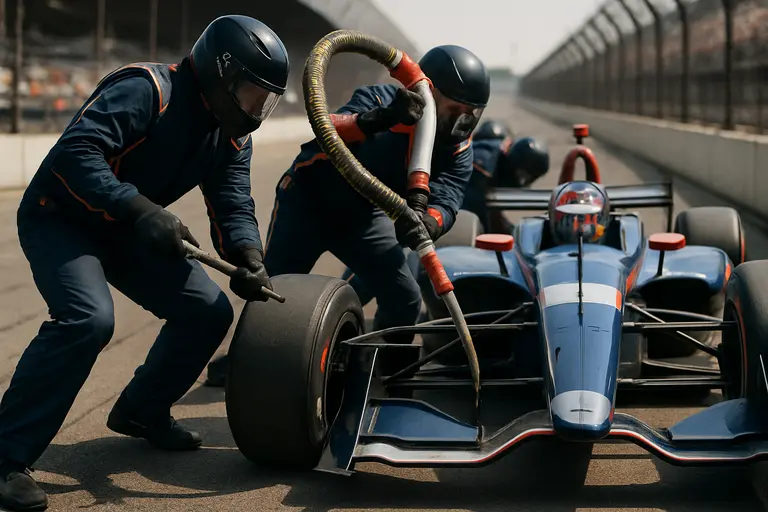
Milwaukee Mile strategy is likely to be defined by tire phase as much as by the opening stint. The research notes that drivers and teams have emphasized late-race tire strategy and short-oval setup as key factors. That fits the track profile. Mild banking tends to punish a car that cannot hold the bottom or rotate consistently as tires age. If a driver has to widen the arc too early in a run, the lap-time loss can compound as traffic forms.
The technical trade is not simple. A car set to fire off strongly after a restart may create track position, but it can also stress the tires before the decisive pit cycle. A car set for longer-run stability may be less dramatic early yet stronger when others are sliding. Across two 250-mile races, the second approach may offer more repeatability, especially if Sunday’s race forces teams to work from lessons gathered under race load on Saturday.
Pit Timing And Caution Windows Could Reset The Order
Fuel use, caution timing and pit stop timing are expected to affect the outcome. The research supports that those areas will likely decide portions of the race, but without race-day caution patterns or fuel numbers, precise stop windows cannot be stated. The safer competitive reading is that teams will value flexibility. A driver who can keep tires underneath the car early in a stint gives the strategist more options if a caution falls near a pit window.
Traffic will also matter. Milwaukee’s short lap means leaders can reach slower cars quickly, and that can alter both tire temperature and pit timing. If a contender is trapped behind traffic near the end of a stint, an earlier stop may gain clean air. If the field is compressed by caution, fresh tires may become more valuable than track position. The doubleheader format increases the pressure because any Saturday mistake becomes data for rivals before Sunday.
- Fast-lap indicator: McLaughlin led the July 8 test at 161.189 mph.
- Close challenger: VeeKay followed at 160.271 mph.
- Track profile: Milwaukee is a 1.015-mile oval with 9-degree turns and 2.5-degree straights.
- 2024 lesson: McLaughlin, Dixon and O’Ward each showed that the two races can produce very different outcomes.
The endurance element is practical rather than abstract. Teams have two races in two days, limited time to reset, and a need to preserve tires and engines while still attacking qualifying and restarts. That makes the July test more valuable as a baseline. The closer the baseline is to race trim, the less a team has to gamble overnight.
Milwaukee Mile Strategy Defines The Doubleheader
The 2026 Milwaukee doubleheader is not only a test of who has the fastest short-oval car on August 29 and August 30. It is a test of who can repeat performance under compressed timing. McLaughlin enters the analysis with the strongest evidence: the top July test speed, a 2024 Milwaukee pole, and a 2024 Milwaukee Race 2 victory. VeeKay’s test pace places him close enough to challenge if his car’s tire life matches its single-lap number.
Dixon’s 2024 recovery drives make him relevant in any strategy-led reading of the weekend, while O’Ward’s 2024 win and later setback show how quickly the competitive order can change between two races at the same track. The event’s defining variable may be the ability to avoid treating Saturday as a complete answer. It will be evidence, not proof.
That is why Milwaukee Mile strategy should be viewed through three linked areas: preserving tire performance late in each stint, using pit timing to escape traffic, and building a setup that can survive both clean-air qualifying and dirty-air racing. The drivers with the best chance are not simply the ones who can post a peak lap. They are the ones whose teams can keep that pace usable when the tires are old, the pit cycle is open and the second race demands a faster reaction than the first.