The Nashville Grand Prix heat story from July 2026 was not just a weather sidebar. It directly changed the competitive shape of the Borchetta Bourbon Music City Grand Prix, compressed the strategic model, and forced event organizers to treat heat management as part of race execution rather than background operations.
The race was originally scheduled for Sunday, July 19, 2026, but heavy rain and lightning forced a postponement. Officials also cut the planned distance from 300 laps to 225 laps because of a forecast for record heat and a heat index above 100°F, as reported by Autosport. That single change removed 75 laps from the event, a 25 percent reduction, and made the rescheduled Monday, July 20 race a very different strategic contest from the one teams had prepared for on paper.
How Nashville Grand Prix heat Changed Race Length
The central effect of Nashville Grand Prix heat was the move from a 300-lap race to a 225-lap race. A shorter distance did not simply mean less running. It altered the value of every lap, every restart, and every pit-lane call because teams had fewer opportunities to correct a poor early sequence.
Distance Reduction And Competitive Compression
At 300 laps, a team can sometimes recover from an early loss of track position through split strategy, tire offset, or caution timing. At 225 laps, those correction windows narrowed. If a driver lost positions on a restart or a crew gave away time during service, there were fewer remaining green-flag cycles in which to rebuild the race.
That compression also increased the cost of conservative decision-making. A team protecting track position could not assume there would be enough distance later to attack on fresher tires. A team chasing clean air had to decide earlier whether to pit before rivals, stay out for caution risk, or commit to a sequence that might become hard to unwind.
| Planning Element | Original Position | Revised Race Effect |
|---|---|---|
| Race distance | 300 laps | Reduced to 225 laps |
| Lost running | None before revision | 75 laps removed |
| Strategic margin | Longer recovery window | Fewer chances to offset errors |
| Weather factor | Scheduled July 19 race | Postponed after rain and lightning |
| Heat factor | Forecast concern | Distance cut tied to heat index above 100°F |
The Monday race start was set for 2 p.m. CT, according to the research supplied for this analysis. That timing still placed the event in demanding afternoon conditions, with forecast ambient temperature around 90°F and heat index values pushing toward 102°F. For drivers, engineers, pit crews, and race control, the revised format meant a shorter but more intense operating window.
Pit Windows Became A Track-Position Problem
Shortening the race placed pit timing closer to the center of the competitive equation. On an oval where traffic, caution timing, and tire state can decide running order, 225 laps left less room for a slow strategic burn. Teams had to treat every stop as both a service event and a positional weapon.
Nashville Grand Prix heat And Pit Timing
Nashville Grand Prix heat increased the practical value of clean air. In hot conditions, cars running in traffic can face worse thermal load and less predictable balance. Even without adding unsupported technical claims, the strategic inference is clear: when the race is shorter and conditions are harsh, gaining track position earlier can be worth more than waiting for a theoretically cleaner tire or fuel window later.
The research notes identify Alex Palou’s July 20 victory as an example of that principle. His race-winning sequence was described as being anchored by entering pit lane just before caution periods, which allowed his team to convert timing into track position. That type of gain is powerful in any IndyCar race, but it carried extra weight at Nashville because the shortened distance reduced the number of later chances for rivals to respond.
Caution Timing And Tire Allocation
Caution periods became especially valuable because they could reset the field while also reducing the number of green-flag laps available for tire degradation to play out. A yellow near the end of a fuel window could reward a team already positioned to stop. A yellow just before a planned stop could trap others in a less favorable sequence.
The research also states that tire strategy involved use of primary and alternate compounds. With fewer laps, each stint represented a larger share of the race distance. That made compound placement more sensitive: the question was not only which tire was faster, but where its performance fit relative to traffic, caution probability, and the reduced opportunity to recover from a badly timed stop.
Event Operations Were Also Part Of Race Control
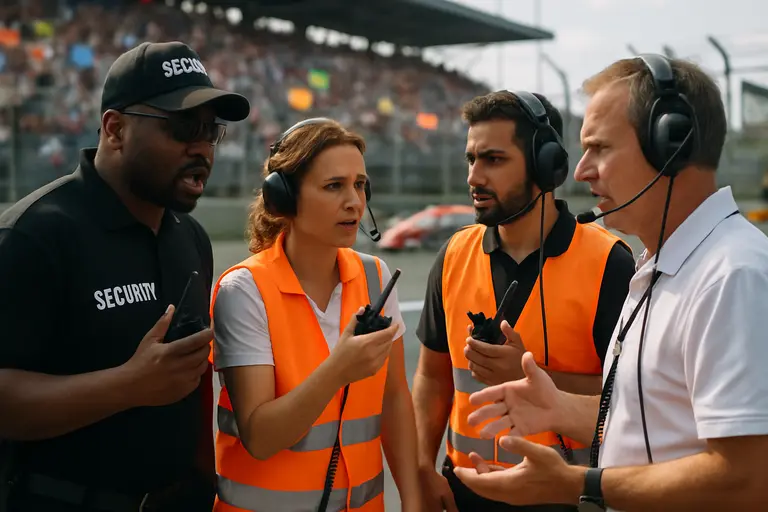
The operational side mattered because weather affected both the race and the venue plan. The postponement was triggered by heavy rain and lightning, then the rescheduled race had to be managed under heat-index pressure. That combination forced organizers to address two different safety problems within the same event cycle: storm disruption first, heat exposure second.
Heat Planning Beyond The Pit Wall
Nashville’s broader emergency-management posture provides useful context. Earlier in July, the Nashville Office of Emergency Management said it was continuing heat patrols into the July 4 weekend, with heat-related outreach and public-safety measures referenced by Nashville.gov. That city-level heat response was not the race plan itself, but it shows that high heat was already a public-safety factor in Nashville before the IndyCar weekend.
For the race venue, the research identifies shade, cooling stations, hydration resources, schedule shifts, and contingency planning as event-planning concerns. In a racing context, those are not peripheral details. If spectators, crews, officials, or support staff are stressed by heat, the event becomes harder to execute cleanly. Pit crews need repeatable physical performance. Officials need clear decision-making. Teams need stable operating routines from garage to grid.
Driver Load And Crew Execution
The driver-side challenge was not only the thermometer reading. Heat index, cockpit temperature, traffic, and race intensity combine to increase physical load. The research notes that drivers faced added cockpit heat, traffic stress, and thermal fatigue, making hydration, cooling preparation, and conditioning meaningful parts of performance.
Pit crews faced a different version of the same stress. Shorter races can appear easier from the outside, but compressed events often raise execution pressure. A single slow stop or procedural miscue carries greater competitive cost when the remaining lap count is smaller. Under heat stress, repeatability becomes a performance measure: crews must deliver the same choreography while the surrounding conditions make fatigue more likely.
Nashville Grand Prix Heat Decisions
The most significant lesson from Nashville Grand Prix heat in July 2026 is that weather management and race strategy were inseparable. The 75-lap reduction changed the mathematical structure of the race. The heat-index forecast changed the operating assumptions. The postponement changed the event rhythm. The Monday start placed teams into a shorter, hotter contest where timing mattered more than volume.
For teams, the key competitive point was compression. Fewer laps meant less tolerance for an early mistake, less time to exploit long-run pace, and greater dependence on pit timing around cautions. For organizers, the key operational point was adaptability. Rain, lightning, heat, and spectator welfare all had to be addressed without losing the integrity of the competition.
The race ultimately showed how quickly an IndyCar event can shift from a standard distance contest into a constrained strategic exercise. At Nashville, heat did not merely reduce the lap count. It changed how teams valued track position, how crews managed workload, how officials structured the event, and how the venue had to prepare for people exposed to harsh afternoon conditions.